
Same car. Same hole. Three prices. Here’s what each tier costs, where the deltas come from, and the one hidden cost that can erase everything you saved.
The three tiers in thirty seconds
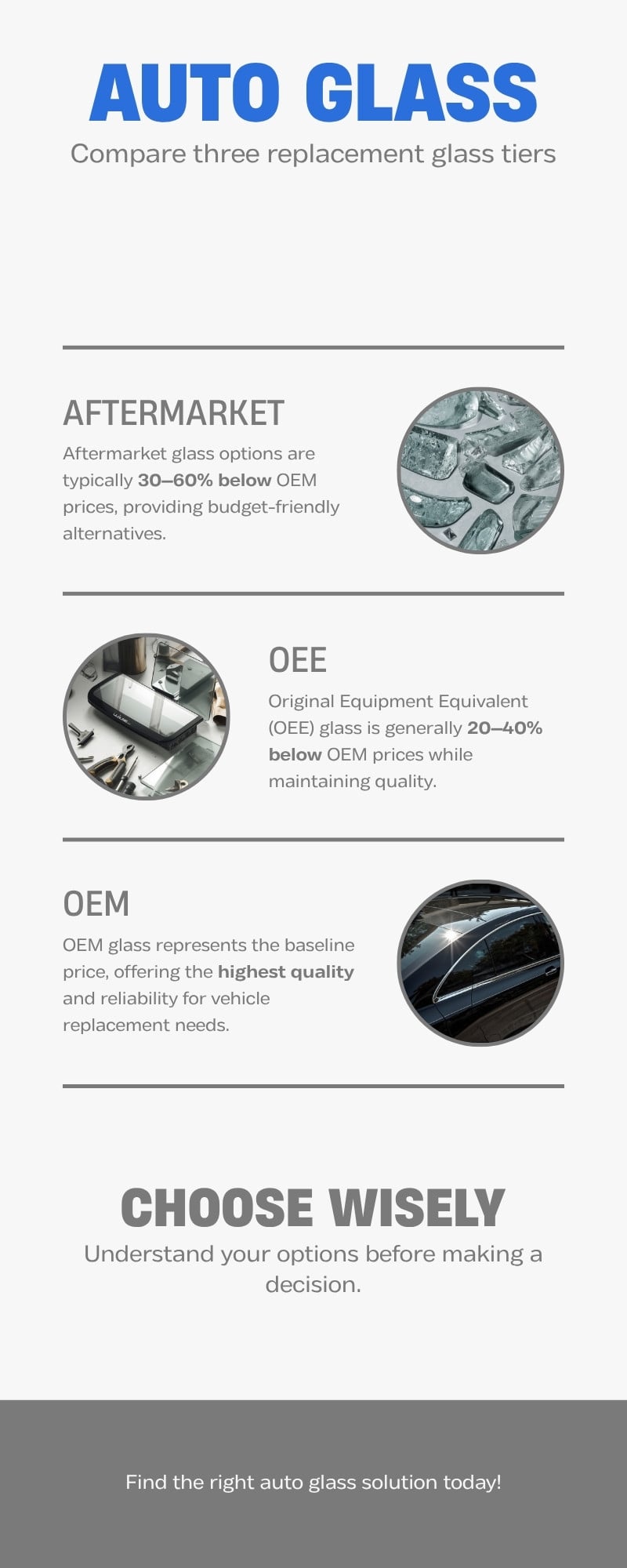
| Tier | Who makes it | Built from | Logo | Typical premium |
|---|---|---|---|---|
| OEM | The automaker’s original glass supplier | The automaker’s own spec | Yes | Baseline high |
| OEE | Often the same suppliers (Pilkington, AGC, Fuyao, Saint-Gobain, Carlex) | Original specs, unbranded | No | 20–40% below OEM |
| Aftermarket | Third-party manufacturers | Reverse-engineered measurements | No | 30–60% below OEM |
All three pass the same federal safety standard (FMVSS 205). The standard sets a floor for impact resistance and clarity. It says nothing about optical precision in the camera zone, acoustic interlayers, or HUD compatibility — which is exactly where the price differences live.
The price deltas, by vehicle class
Installed prices — glass, labor, standard moldings. Calibration excluded (it’s tier-neutral; more on that below).
| Vehicle class | Aftermarket | OEE | OEM |
|---|---|---|---|
| Compact sedan, no ADAS (2014 Civic) | $250–$350 | $350–$450 | $450–$650 |
| Mid-size SUV with camera (2022 CR-V) | $280–$400 | $440–$550 | $650–$900 |
| Full-size truck, heated glass (F-150) | $350–$500 | $500–$700 | $700–$1,000 |
| Luxury with HUD (BMW X5 class) | Often unavailable | $900–$1,200 | $1,200–$2,000+ |
Read the pattern: the OEM premium runs $150–$300 on mainstream vehicles and $300–$800+ on luxury and HUD-equipped glass — where OEM is sometimes the only option that supports the features at all. And note the luxury row’s aftermarket column: for HUD and heavily optioned glass, cut-rate panes frequently don’t exist. The “cheap option” isn’t on the menu.
Calibration: tier-neutral price, tier-sensitive risk
If your vehicle has a forward camera (nearly everything 2018 and newer), add $150–$600 for ADAS calibration — static, dynamic, or dual depending on the vehicle. The calibration fee is the same no matter which glass you buy.
The risk isn’t. Calibration is an optical process: the camera has to see the road accurately through the glass. Installers report that when calibrations fail repeatedly, the fix is often swapping budget glass for OEM or high-grade OEE. Every failed attempt is a rebooked appointment, and depending on the shop’s policy, potentially another calibration fee.
Run that failure case: a $280 aftermarket pane that needs a re-glass and re-calibration just became $280 + $440 (OEE redo) + $300 (second calibration) = $1,020 — more than buying the $650 OEM windshield on day one. You won’t hit that case often. But it’s the tail risk you’re accepting when you buy the cheapest pane for a camera car.
What insurance pays for
The default across most carriers: “like kind and quality,” which means OEE or aftermarket. Your realistic options, in order of cost to you:
- OEM endorsement on your policy — some carriers sell
it; if you drive something HUD-equipped, it’s worth the rider. - Ask at claim time — some adjusters approve OEM for
newer vehicles or feature-matched glass if you push. Free to ask. - Pay the delta yourself — insurer covers the OEE
price, you cover the gap to OEM. On a mainstream vehicle that’s a
$150–$300 decision, not a $900 one.
Leased vehicle? Read the lease before the claim. Some lease agreements specify OEM parts, and a lease-return inspector who finds an unbranded windshield can bill you the difference at turn-in — after you already paid for the aftermarket pane.
Decision rules
Skip the philosophy. Match your row:
| Your situation | Buy | Why |
|---|---|---|
| Pre-2015 vehicle, no camera, no HUD | Aftermarket | Nothing on the car can tell the difference |
| Camera-equipped, keeping the car | OEE | Original-supplier quality, clean calibrations, 20–40% saved |
| HUD or acoustic package | OEM (or verified feature-match OEE) | The features fail on generic glass |
| Leased or selling within a year | Check lease terms / OEM | The logo can matter at inspection |
| Insurance paying, you want OEM | Ask, then pay the delta | Usually a $150–$300 gap, not full price |
Bottom line
The tier question is a $150–$300 question on most cars and a $500+ question on luxury glass. Aftermarket is the right call on a simple windshield, OEE is the right call on almost everything with a camera, and OEM is the right call when the glass does more than keep the wind out. Get the shop to name the tier and the brand on the quote. If the quote just says “windshield,” you don’t have a quote — you have a guess.
Compare real numbers for your own car — see windshield replacement cost by make and model.